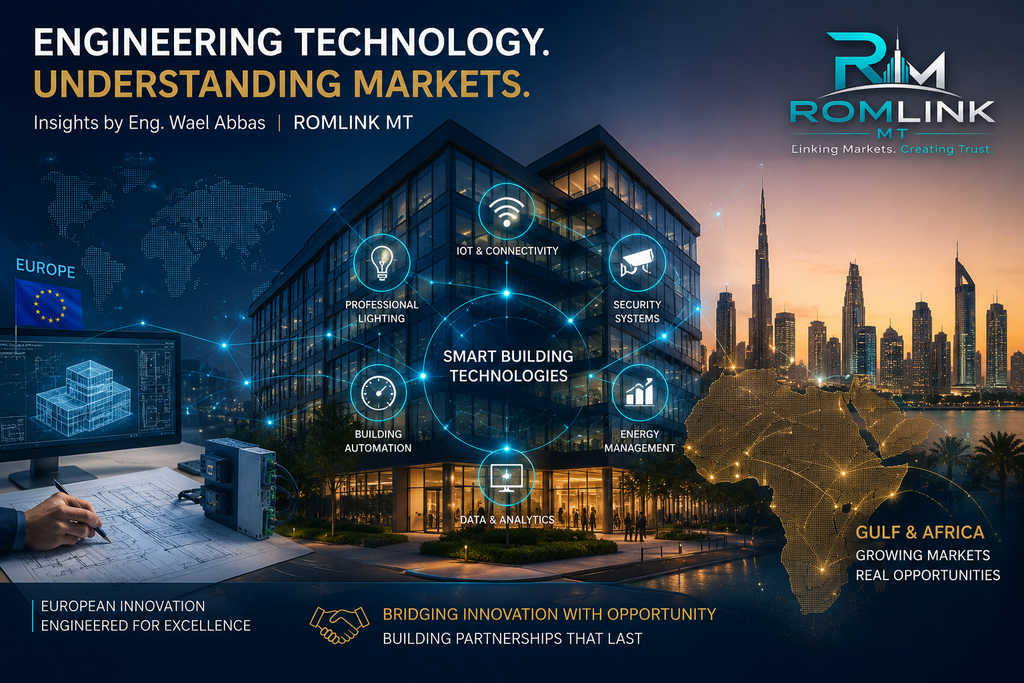
The global smart-building industry is entering an important new phase.
Innovation is no longer concentrated only in mature European markets. Across the Gulf and Africa, investment in infrastructure, digitalization, energy efficiency and smarter urban environments is creating new opportunities for technologies ranging from building automation and IoT sensors to professional lighting and security systems.
For European technology manufacturers, however, having an excellent product is only the beginning.
One lesson I have learned through engineering and international business development is that technology must fit the market in which it is deployed.
And that requires something beyond technical specifications.
It requires local market intelligence.
Engineering Excellence Alone Does Not Guarantee Market Success
European manufacturers have built strong reputations in areas such as:
- Smart building systems
- IoT sensors and automation
- Professional lighting
- Security technology
- Energy management
- Building control systems
- Connected infrastructure
Technically, many of these solutions are highly suitable for projects developing across Gulf and African markets.
Commercially, however, entering these regions can be much more complicated.
A manufacturer needs to understand who specifies the technology, who approves it, who integrates it, who distributes it and—most importantly—who ultimately makes the purchasing decision.
This is where engineering knowledge and market knowledge need to meet.
The Gulf: Technology Meets Ambitious Infrastructure Development
Saudi Arabia provides a powerful example.
The country's Vision 2030 transformation continues to support technology adoption, digital infrastructure and smarter urban development. The 2025 Vision 2030 Annual Report highlights continued investment in technologies including 5G, fiber infrastructure and IoT, while major developments remain central to the Kingdom's transformation agenda.
For technology manufacturers, developments of this scale can create opportunities across multiple layers of the built environment.
A modern intelligent building may require sensors to understand occupancy, automation platforms to control systems, professional lighting to improve efficiency and user experience, security technology to protect assets, and connected systems capable of communicating with each other.
But identifying demand is different from converting that demand into business.
Manufacturers must understand the ecosystem surrounding a project: consultants, developers, contractors, system integrators, distributors and decision-makers.
Africa Should Not Be Treated as One Market
Africa presents a different opportunity—and requires a different strategy.
One of the biggest mistakes international companies can make is approaching Africa as if it were a single homogeneous market.
It is not.
Countries differ significantly in infrastructure maturity, procurement structures, regulation, financing, distribution networks and technology requirements.
At the same time, infrastructure development continues across the continent. Recent World Bank initiatives, for example, include climate-smart urban infrastructure investment in Uganda and major urban-resilience investment in Madagascar. The broader Mission 300 initiative has also reported connecting more than 50 million people to electricity across 40 African countries as part of a much larger infrastructure objective.
These developments point toward something important for technology companies:
Africa's opportunity is not simply about selling more technology. It is about solving specific infrastructure problems with the right technology.
Why Local Intelligence Matters
Before entering a new market, I believe manufacturers should ask several questions.
Who are the relevant decision-makers?
Which projects genuinely match our technology?
What certifications or approvals are required?
Should we work through distributors, integrators or direct representation?
Who influences specifications before procurement begins?
What does the competitive environment look like?
And perhaps most importantly:
Who can we trust locally?
These questions are commercial, but answering them properly often requires technical understanding as well.
A business developer who does not understand the technology may struggle to recognize the right project.
An engineer who does not understand the commercial environment may recognize the technical opportunity but struggle to convert it into business.
The strongest market-entry strategy connects both worlds.
The Role of ROMLINK MT
This thinking is at the heart of why I founded ROMLINK MT.
Based in Romania, our objective is to connect European technology manufacturers with carefully identified opportunities across Gulf and African markets.
Our focus includes smart building systems, professional lighting solutions, security technology, sensors, automation and IoT.
But ROMLINK MT is not intended to be simply another intermediary between a manufacturer and a buyer.
Our objective is to understand the technology, understand the market, identify where the two genuinely fit, and then help build the relationships necessary to move opportunities forward.
That means looking beyond individual transactions toward sustainable commercial partnerships.
From Technology Export to Market Partnership
The future of international technology expansion will not belong only to companies with the best products.
It will belong to companies capable of combining:
European innovation.
Engineering understanding.
Regional intelligence.
Trusted relationships.
Long-term market development.
As an engineer and the founder of ROMLINK MT, this is the intersection that interests me most.
Technology can make buildings smarter.
But understanding people, projects and markets is what turns technology into opportunity.
Eng. Wael Abbas
Founder | ROMLINK MT
Linking Markets. Creating Trust.